
If there's one reading routine I wish every second-grade teacher would implement, it's consistent, purposeful fluency practice.
I've taught second grade, worked as a reading teacher, and spent years helping students develop the foundational skills they need to become successful readers.
And one of the biggest lessons I've learned is this:
Reading fluency doesn't improve because students read a passage one time. It improves when they have consistent opportunities to practice, receive feedback, and recognize their own growth.
I've seen incredible reading growth in my own second-grade classroom using simple fluency routines.
Not complicated programs. Not hours of additional instruction. Just intentional, repeated practice that students could actually manage independently.
The routines were so effective that I created an entire collection of 2nd Grade Reading Fluency Passages to help other teachers implement them.
And although these passages were designed for second grade, the same routines work beautifully for third-grade students who need additional fluency practice!
Why Reading Fluency Matters So Much in 2nd and 3rd Grade
Second grade is a pivotal year in reading development.
Many students enter second grade still working hard to decode individual words. By the end of the year, we want them reading connected text more accurately, smoothly, and confidently.
But here's the challenge.
When students have to devote so much mental energy to figuring out individual words, they have fewer resources available to think about what the text actually means.
That's why fluency is such an important bridge between decoding and comprehension.
Fluent readers are developing three essential skills:
Accuracy: Reading the words correctly.
Automaticity: Recognizing words efficiently without having to labor over every sound.
Prosody: Reading with appropriate phrasing, expression, and attention to punctuation.
As these skills develop, students can focus more attention on understanding what they're reading.
And that's our ultimate goal.
We don't just want faster readers. We want students who can read accurately, understand the text, and enjoy the process.
The Simple Reading Fluency Routine That Worked in My Classroom
When I started focusing more intentionally on fluency, I wanted a routine that would be easy to teach, simple to manage, and effective enough to use consistently.
I didn't want another complicated system that required hours of preparation.
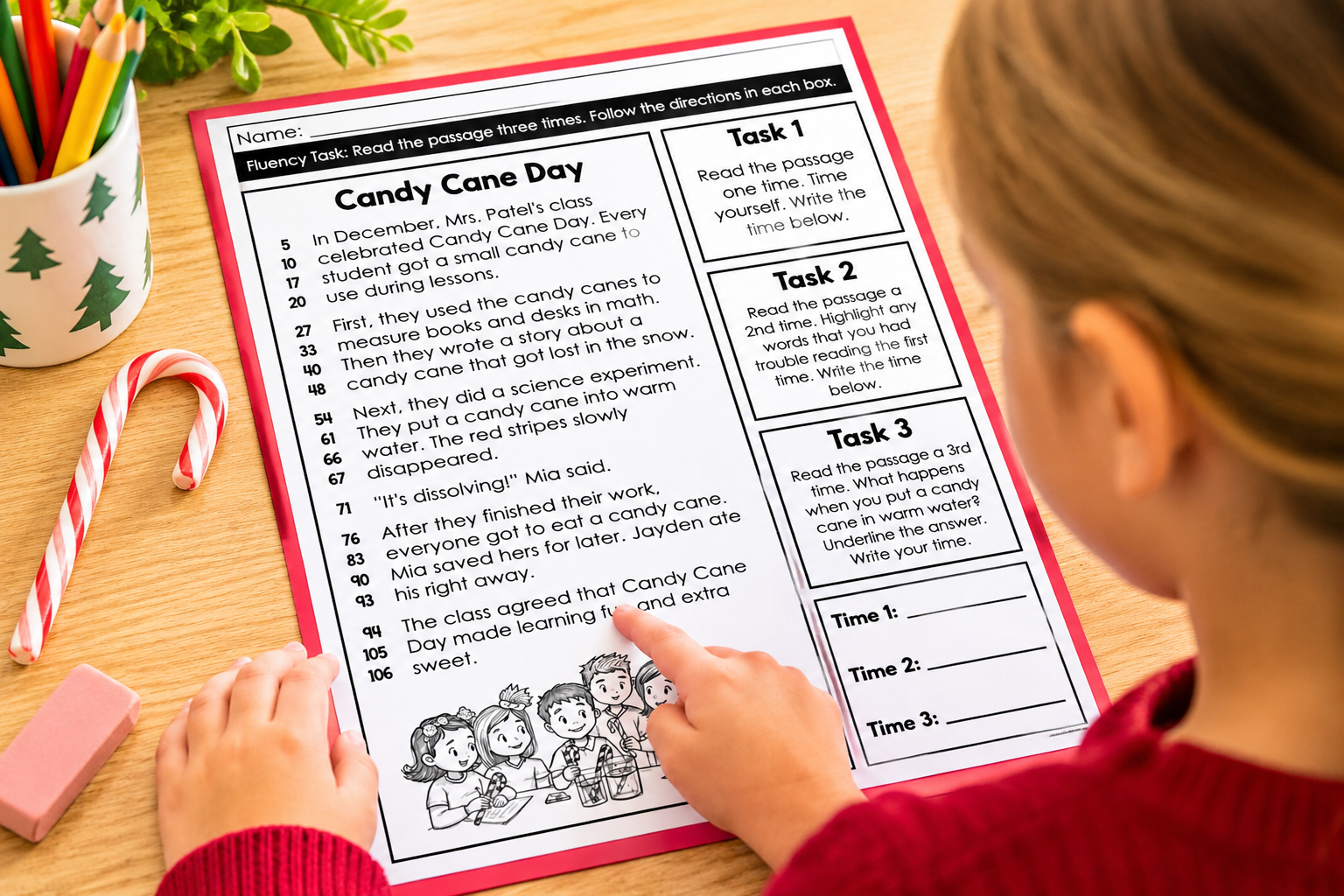
I wanted students actually reading.
The routine I built my fluency passages around follows four simple steps:
Read → Reread → Practice → Respond
Here's how teachers can use that structure throughout the week.
Step 1: Introduce the Fluency Passage
At the beginning of the week, introduce a new passage.
Before students begin reading, take a few minutes to discuss the topic, preview unfamiliar vocabulary, and provide any decoding support they need.
This is especially important for students who are still developing foundational reading skills.
You want the passage to be appropriately challenging without becoming so difficult that students spend the entire time struggling through individual words.
For students who need additional support, model a fluent reading of the text or practice a challenging section together.
The goal is to prepare students for successful reading practice.
Step 2: Reread the Same Passage Throughout the Week
This is where so much of the growth happens!
Instead of giving students a different passage every day, provide multiple opportunities to read the same text.
The first reading might be slow and require significant effort.
During the second reading, students begin recognizing words they previously struggled with.
By the third or fourth reading, many students become more comfortable with the vocabulary, sentence structures, and overall flow of the text.
This familiarity creates opportunities to improve accuracy, automaticity, and expression.
Students begin noticing that something that felt difficult earlier in the week is becoming easier.
And that feeling of success is incredibly motivating!
Step 3: Incorporate Partner Reading and Feedback
Partner reading is one of my favorite ways to make fluency practice manageable.
Once students understand the expectations, they can practice reading aloud with a partner while the teacher works with small groups.
Partners can listen for accurate reading, encourage appropriate expression, and help each other notice places that need another attempt.
It's important to explicitly teach students how to be supportive partners.
The goal isn't to race each other or compare reading speeds.
It's to become stronger readers together.
You can also incorporate teacher-led practice for students who need more intensive support.
Step 4: Respond to the Text
Fluency and comprehension should never be completely separate.
That's why I love pairing repeated reading with meaningful comprehension tasks.
After students have practiced reading a passage, ask them to demonstrate what they understood.
They might answer comprehension questions, identify important details, summarize the text, or discuss the author's message.
This helps reinforce that fluent reading is about making meaning, not simply getting through the words quickly.
We want students to become better readers, not just better timers.
How I Use Reading Fluency Data to Track Student Growth
One of the most powerful parts of a consistent fluency routine is being able to see student progress over time.
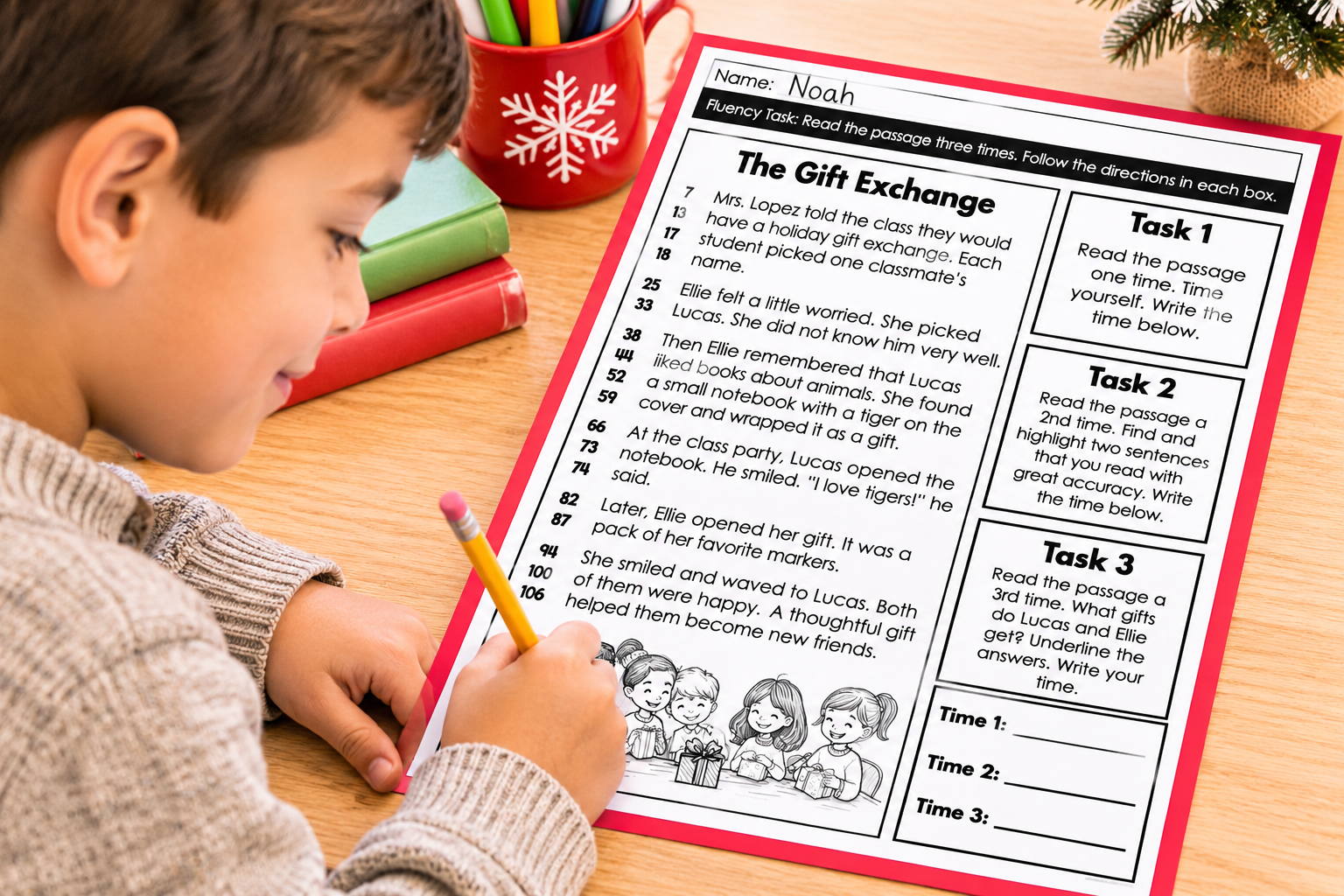
When students practice regularly and teachers collect meaningful data, it's much easier to identify who is growing and who needs additional support.
One common measure is words correct per minute, or WCPM.
To calculate WCPM, count the words a student reads in one minute and subtract the words read incorrectly.
For example, if a student reads 85 words in one minute and makes 7 errors, their score is 78 words correct per minute.
But WCPM is only one piece of the puzzle.
I also want to know:
Is the student making fewer decoding errors?
Are they recognizing familiar words more automatically?
Are they reading in meaningful phrases?
Are they paying attention to punctuation?
Can they explain what they've read?
These observations help teachers make better instructional decisions.
I also love giving students opportunities to see their own progress.
When students can look back at earlier readings and recognize how much they've improved, it builds confidence and motivation.
One important distinction: for formal progress monitoring, use comparable passages and consistent administration procedures. Students' improvement on a familiar, repeatedly practiced passage is valuable feedback, but it isn't the same as measuring their growth on an unfamiliar passage.
Why I Created My Year-Long Reading Fluency Passages
After seeing how much my students benefited from consistent fluency routines, I wanted to make the process easier for other teachers.
Because the truth is, the routine itself isn't complicated.
The time-consuming part is finding appropriate passages, preparing meaningful follow-up activities, and keeping everything organized week after week.
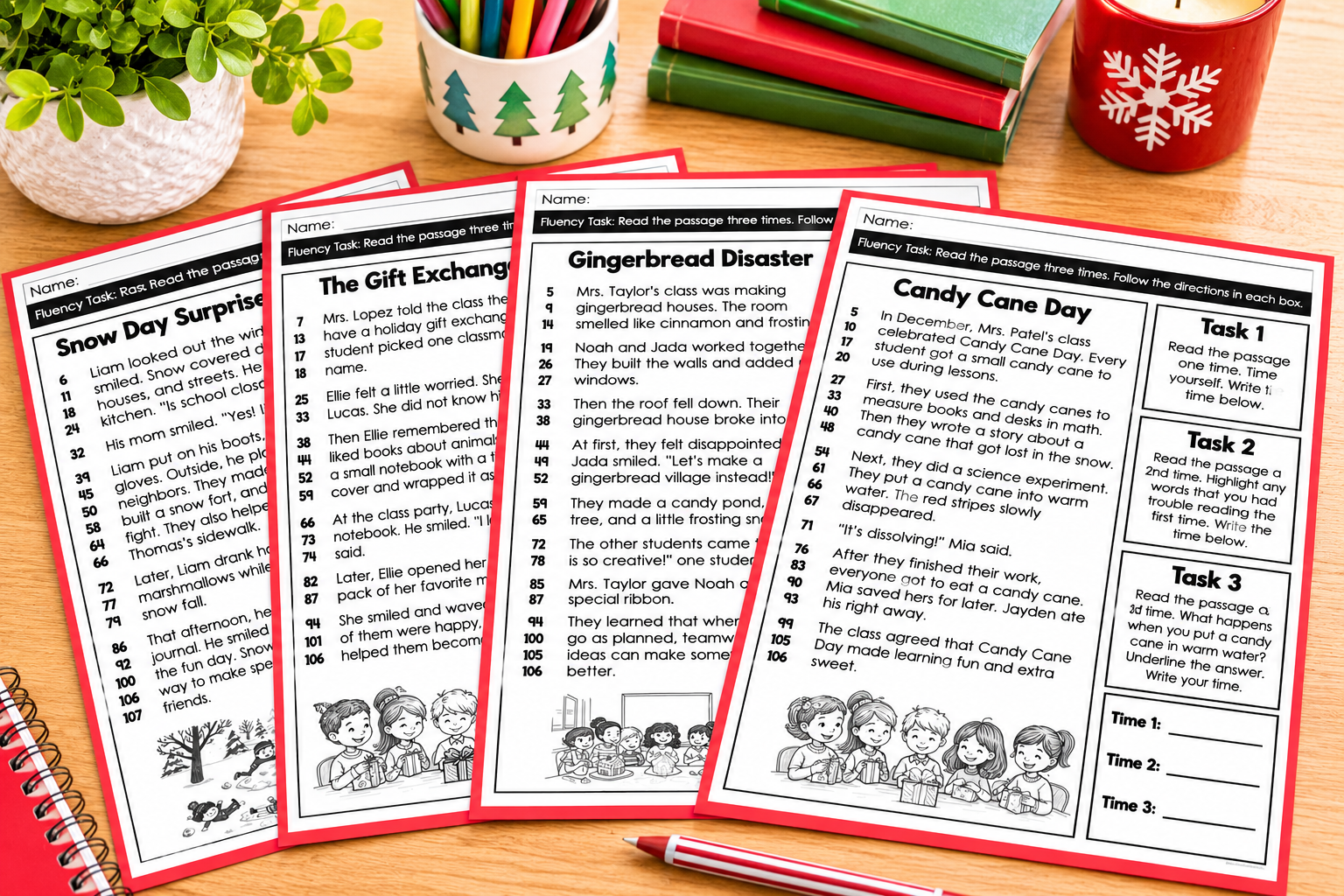
That's why I created my Reading Fluency Passages Year-Long Bundle for 2nd Grade.
The collection includes monthly sets of fiction and nonfiction passages designed for purposeful, repeated reading practice.
The passages gradually increase in length and complexity throughout the school year, so students can continue building their reading stamina and confidence.
The resource includes:
Engaging fiction and nonfiction fluency passages
Two reading levels to support different readers
Repeated-reading opportunities
Comprehension follow-up activities
Seasonal and high-interest reading topics
Student-friendly pages for independent practice
Flexible options for homework, small groups, centers, and intervention
The goal was to create something teachers could use consistently without needing to reinvent their reading routine every week.
Print the passage. Teach the routine. Let students practice.
It's simple, but that consistency matters.
How to Use These Fluency Passages in 3rd Grade
Although this collection was designed with second-grade readers in mind, I also recommend the routine for third-grade classrooms.
Here's why.
Not every student enters third grade reading fluently.
Some students are still working to develop automatic word recognition. Others can decode accurately but read slowly or without expression.
And some students need additional support connecting fluent reading with comprehension.
For these readers, appropriately leveled second-grade fluency passages can be a useful intervention tool.
Third-grade teachers can use the same repeated-reading structure during small groups, intervention blocks, partner reading, or independent practice.
For students who are already reading fluently at grade level, choose appropriately challenging third-grade texts while keeping the same routine.
The routine doesn't have to change just because the grade level does.
That's one of the things I love most about this approach.
Once students understand how to practice fluency purposefully, the structure can follow them as their reading skills develop.
Five Ways to Fit Fluency Practice into an Already Busy Reading Block
I know what you're thinking.
This sounds great, but where am I supposed to find the time?
The good news is that fluency practice doesn't have to become an entirely separate instructional block.
Here are five practical ways to fit it into your existing schedule.
1. Fluency Folders
Give each student a folder to store their current passages and reading records.
Students can return to familiar passages throughout the week, keep their materials organized, and see their progress over time.
2. Partner Reading
Build a short partner-reading routine into your literacy block.
Once students learn the expectations, they can practice reading aloud while you meet with small groups.
3. Small-Group Instruction
Use fluency passages with students who need targeted instruction in accuracy, automaticity, or expression.
Model fluent reading, provide corrective feedback, and give students opportunities to practice.
4. Fluency Homework
Send a familiar passage home for additional practice.
Families can listen to their child read and offer encouragement.
Keep the routine short, positive, and manageable so home practice doesn't become stressful.
5. Reading Intervention
Repeated reading can be especially useful for students who need additional fluency support.
Pair appropriately leveled passages with explicit decoding instruction when necessary, and monitor students' progress to determine whether the intervention is working.
The important thing is choosing a routine that you can maintain consistently.
A simple routine that happens regularly is often more useful than an elaborate activity that only happens occasionally.
Don't Forget: Reading Fluency Is About More Than Speed
I want to emphasize this because it's so important.
When we talk about reading fluency growth, it's easy to focus entirely on how many words a student can read in one minute.
And while reading rate can provide useful information, it shouldn't be the only thing we're measuring.
A student who reads quickly but makes frequent mistakes isn't necessarily reading fluently.
Neither is a student who races through a passage without understanding it.
Strong fluency instruction should help students become more accurate, more automatic, more expressive, and more confident.
That's why I love combining repeated reading with comprehension activities and meaningful feedback.
We're building readers who understand what they're reading.
And that is so much more valuable than simply beating a timer.
Small Routines Can Lead to Big Reading Growth
Some of the most meaningful reading growth I've seen in my classroom came from doing simple things consistently.
We didn't need a complicated system.
We needed appropriate texts, repeated opportunities to practice, clear expectations, and a way to recognize student progress.
Over time, students who once struggled through passages began reading with greater confidence.
They could recognize their own improvement, and I could use what I was seeing to make better instructional decisions.
That's why I'm such a believer in intentional reading fluency practice.
If you're looking for a way to strengthen reading fluency in your second-grade classroom—or support third graders who need additional practice—I encourage you to start with one simple routine.
Choose a passage. Read it. Reread it. Practice. Respond.
Then keep going.
Because meaningful reading growth doesn't always come from doing more. Sometimes it comes from doing the right things consistently.
Explore the 2nd Grade Reading Fluency Passages Year-Long Bundle on TPT!
Simple solutions. Strong results.