
What if you could tell in just five questions whether a student truly understands a math skill?
Not just whether they can follow the steps you taught yesterday. Not just whether they can solve a problem that looks exactly like the example on the board.
But whether they actually understand the math.
As teachers, we're constantly collecting data. We give unit tests, administer benchmark assessments, check independent work, and watch students solve problems during small groups. But sometimes, even with all that information, it's difficult to answer a really important question:
Does this student understand the skill well enough to move on?
That's exactly why I created my 2nd–5th Grade Math Quick Checks.
These short, standards-aligned math assessments are designed to help teachers identify learning gaps, check prerequisite skills, plan targeted math intervention, and determine whether students are ready for more challenging instruction.
And the best part? Each quick check has just five carefully designed questions.
Why Five Questions Can Tell You More Than a Page of Practice Problems
Think about a typical math worksheet. Students might solve 15 multiplication problems, all presented in exactly the same format. A student who understands the procedure could get every single question correct.
But what happens when that same multiplication skill appears in a word problem? Or a visual model? Or an error-analysis question? Suddenly, the student who seemed to have mastered multiplication is struggling.
I see this all of the time in my own math classroom. We teach a skill concretely, then move on to numbers and equations…but when the unit math test comes around, the questions with the lowest success rate are always the word problems, application problems, and problems with more abstract thinking.
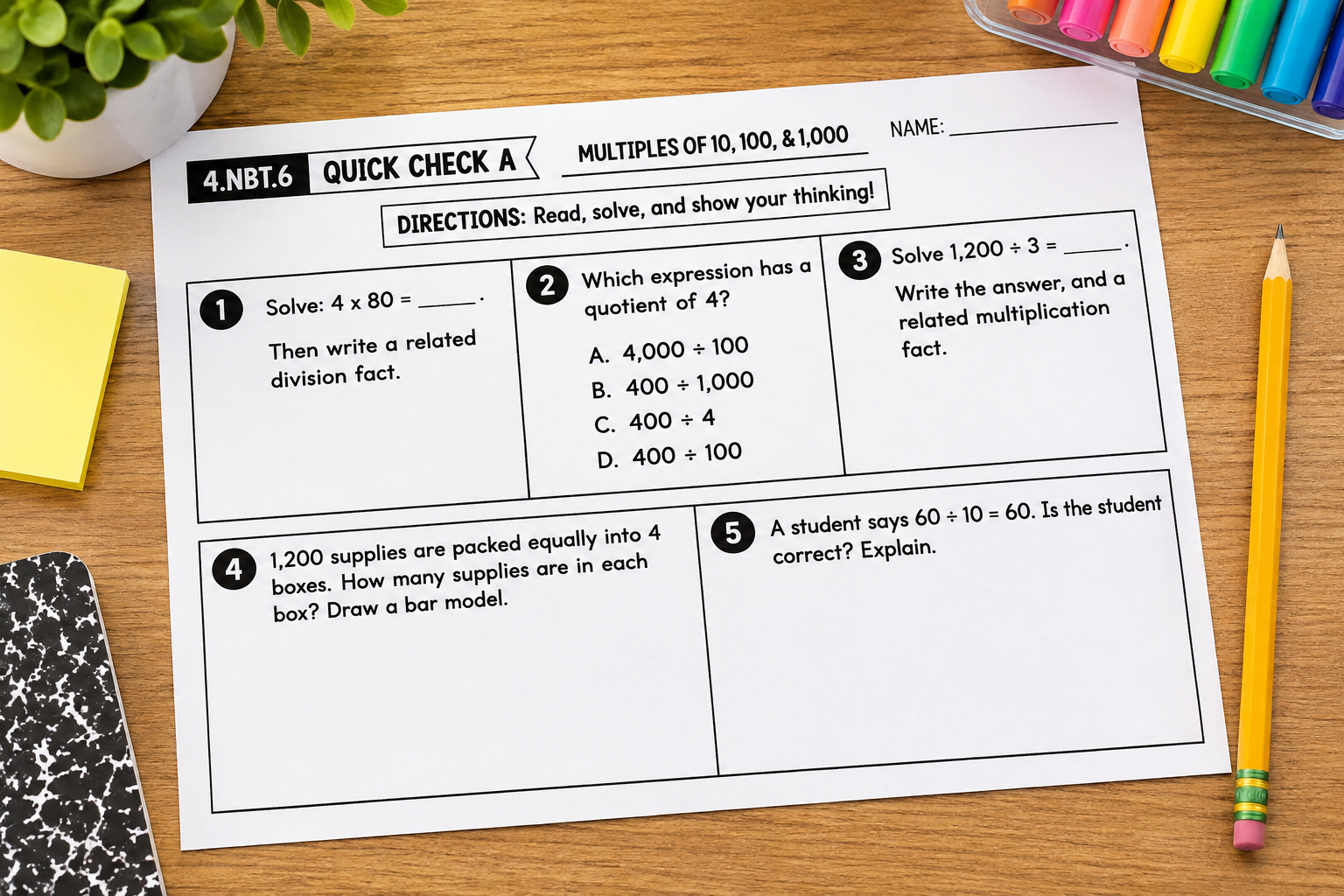
I wanted my Math Quick Checks to assess more than whether students could solve a familiar type of problem. Each quick check includes five questions that assess the same mathematical skill in different ways.
Depending on the skill, students may encounter:
Multiple-choice questions that require them to identify the correct answer or mathematical reasoning.
Visual models that connect abstract math concepts to concrete representations.
Word problems that ask students to apply the skill in a real-world context.
Error analysis that challenges students to identify and explain mathematical mistakes.
Open-ended questions that require students to demonstrate their thinking.
Traditional computation that checks accuracy and procedural fluency.
Not every quick check includes every question type, but the goal is always the same: assess the skill from multiple angles.
Instead of answering five nearly identical questions, students have five opportunities to show what they really know.
When a student can correctly answer all five different types of questions, that's strong evidence that they have a deep understanding of the skill and are ready to move forward.
And when they can't? Their responses help us figure out exactly where instruction needs to go next.
Use Math Quick Checks to Find Learning Gaps Across Grade Levels
One of my favorite ways to use these math assessments is to identify prerequisite skill gaps.
We all know that students don't arrive in our classrooms with perfectly mastered skills from the previous grade.
A fourth grader might be struggling with multi-digit division because they never developed strong multiplication fact fluency.
A fifth grader might have difficulty multiplying decimals because their understanding of whole-number place value is shaky.
And a third grader who struggles with rounding might actually need more instruction on the value of digits in a three-digit number.
Sometimes the skill we're teaching isn't the skill that's causing the problem.
The real learning gap is hiding underneath it.
Because these Math Quick Checks are available for 2nd, 3rd, 4th, and 5th grade, teachers can assess foundational skills from earlier grade levels without giving students an entire unit test.
Example: A Fourth Grader Struggling With Division
Imagine you're teaching fourth-grade division, and several students are struggling to divide larger numbers. You could continue reteaching the fourth-grade division algorithm. But what if the real issue is that students don't understand the relationship between multiplication and division?
Instead, you could use a third-grade division quick check to see whether students can:
Represent division using equal groups or arrays.
Connect multiplication and division using related facts.
Interpret division word problems.
Solve basic division equations.
Now you have information that can actually guide your intervention. Rather than spending another week reteaching a procedure students aren't ready for, you can address the missing foundational skill first.
Five Ways to Use Math Quick Checks in Your Classroom
The beauty of these printable math assessments is that they can fit into routines you already have.
You don't need to create an entirely new assessment system or rearrange your math block.
1. Use Them as Math Exit Tickets
At the end of a lesson or short sequence of lessons, give students a quick check aligned with the skill you've been teaching.
Use the results to determine who is ready for independent practice, who needs additional instruction, and who may benefit from a challenge.
Because each check includes five questions, it's easy to review responses and spot patterns.
2. Use Them to Create Targeted Math Small Groups
Instead of grouping students based only on their overall math scores, use the quick checks to group students by specific instructional needs.
For example, you might discover that one group understands multiplication computation but struggles with word problems.
Another group can solve multiplication problems using models but needs help connecting those models to equations.
Those students don't necessarily need the same intervention.
Different mistakes tell us different things about what students need.
3. Use Them for Math Intervention and RTI
Math intervention time is valuable, and teachers need a way to determine which skills students have mastered and which ones still need attention.
Math Quick Checks can serve as short, targeted skill assessments during intervention.
You can assess a specific skill, provide focused instruction, and use another check on the same skill to see whether students can apply what they've learned.
This makes them useful for monitoring progress within a particular skill, alongside other classroom and intervention data.
4. Use Them as Prerequisite Skills Assessments
Before teaching a new concept, assess the skills students should already know.
This is especially helpful when moving between grade-level concepts that build directly on one another.
If students demonstrate a strong understanding of the prerequisites, you can begin the new unit with greater confidence.
If they struggle, you know exactly where to start reviewing.
5. Use Them to Determine Who Is Ready to Move On
Not every student needs the same amount of practice.
Some students demonstrate a strong understanding of a skill after only a few lessons. Others need additional models, explanations, or practice.
These Math Quick Checks help you see the difference.
A student who answers all five varied questions correctly has provided strong evidence of understanding across multiple representations and applications.
That student may be ready for the next skill, more complex problems, or enrichment activities.
A student who misses questions gives you useful information about what still needs to be developed.
The goal isn't to keep students practicing until everyone finishes the same number of worksheets. The goal is to make sure students understand the math.
Less Guesswork. Better Math Instruction.
There is no shortage of math data in our classrooms.
We have benchmark scores, unit assessments, computer-generated reports, and pages of student work.
But sometimes, what we really need is something much simpler.
A way to look at one specific math skill and answer:
Does this student understand it?
What part is still confusing?
What should I teach next?
That's what I wanted these Math Quick Checks to do.
They're short enough to fit into a busy classroom routine, but thoughtfully designed to give teachers meaningful information.
Five questions. Different representations. One focused mathematical skill.
Because the goal of assessment isn't just to collect another score.
It's to figure out what students need next—and make sure they're truly ready when we move on.
Ready to Make Your Math Assessments More Meaningful?
Explore the 2nd–5th Grade Math Quick Checks from The Simple Classroom!
Whether you're looking for printable math exit tickets, standards-aligned formative assessments, prerequisite skill checks, or resources for targeted math intervention, these quick checks are designed to help you make the most of your instructional time.
Find the grade level and skill your students need, print a quick check, and start collecting information you can actually use.
Teach it. Check it. Move on.
Because when we know what students understand, we can spend less time guessing and more time teaching exactly what they need.